

TLDR:
- A public limited company (PLC) is a UK business structure that can offer its shares to the public.
- A PLC is a separate legal entity from its owners.
- Shareholders have limited liability, meaning they are only responsible for the amount they invest.
- The company is owned by shareholders and managed by directors.
- PLCs are typically larger, established businesses seeking substantial capital for growth.
- Forming a PLC requires meeting strict legal requirements, including minimum share capital and regulatory compliance.
What Is a Public Limited Company (PLC)?

Most companies who want to become a PLC start searching for accountants near me to answer all of their questions. In this article we’re going to clear everything up so it makes that conversation much easier. A public limited company (PLC) is a UK business structure that can offer its shares to the public and is usually listed on a stock exchange, such as the London Stock Exchange. A PLC is a separate entity from its owners, meaning it has a distinct legal status that provides protection from liabilities and debts. Unlike sole traders or private limited companies, a PLC is owned by shareholders and managed by directors, with ownership spread across anyone who purchases shares.
One of the defining features of a public limited company is limited liability. This means shareholders are only responsible for the amount they invest in the company’s shares, their personal assets are protected if the business faces financial difficulties. Public limited companies exist as separate legal entities from their owners, providing limited liability.
PLCs are typically larger, more established businesses that want to raise substantial capital to fund expansion, acquisitions, or long-term growth. The process of company formation for a PLC involves meeting specific legal requirements, such as compliance with regulations set by the Financial Reporting Council (FRC). Company formation services can assist with navigating these legal and regulatory steps. However, going public also brings stricter regulation, increased transparency, and greater scrutiny from investors and regulators.
What Does PLC Stand For?
PLC stands for Public Limited Company.
In the UK, any company registered as a public limited company must include either “PLC” or the full term “public limited company” at the end of its legal name. This makes it clear to investors, customers and regulators that the business is publicly owned and allowed to offer shares to the general public.
For example, you may see well-known companies with names such as:
- Unilever plc
- Rolls-Royce Holdings plc
- AstraZeneca plc
The “PLC” designation signals that the company is subject to stricter regulatory and reporting requirements than a private limited company (Ltd).
Is a PLC the Same as a Publicly Traded Company?
In most cases, yes.
A public limited company is the UK equivalent of a publicly traded corporation in the United States (often labelled “Inc.” or “Corp.”). PLCs can have publicly traded shares, which are listed on public markets such as the London Stock Exchange. A public limited company is a company whose shares are listed on a stock exchange and can be bought and sold by retail and institutional investors.
PLCs can list their shares on a recognised stock exchange, such as the London Stock Exchange, where investors can buy and sell shares freely. These shares can be freely sold and traded on the stock exchange, providing liquidity for shareholders. The process by which a private company becomes a PLC and lists its shares on public markets is called an initial public offering (IPO), which allows the company to raise substantial capital for growth and expansion.
However, it’s worth noting that not every PLC must be listed on a stock exchange, although many are. The key distinction is that a PLC is legally permitted to offer its shares to the public.
How Does a Public Limited Company Work?

A public limited company works by separating ownership from management.
The company is owned by public shareholders, who purchase the company’s shares in the business. Each share represents a portion of ownership, and shareholders may receive dividends (a share of the profits) and voting rights on key decisions. Because anyone can purchase the company’s shares, ownership is broad, which can dilute a unified company vision.
The company is managed by company directors, who are responsible for governance, oversight, and ensuring compliance with regulations. The management of a PLC is typically vested in a Board of Directors and often a CEO, who oversee daily operations. The Chief Executive Officer (CEO) is responsible for the day to day running of the company, guided by the board’s strategic direction.
If you are a business owner considering forming a PLC, it’s important to understand the roles of company directors and public shareholders, as well as the implications of broad public ownership.
Ownership Through Shares
When a company becomes a PLC, it can raise money by issuing shares to the public. Selling shares on a stock exchange is the primary method for raising more capital, as it opens the company to public investment from a wide range of investors. This enables PLCs to raise significant capital, often far more than a private limited company could access through private investors alone. The ability to raise capital through public investment allows public limited companies to fund major expansion projects and research and development activities.
Shareholders:
- Own part of the company
- Have limited liability
- Can vote at Annual General Meetings (AGMs)
- May receive dividend payments
Public Reporting and Transparency
Because PLCs can raise money from the public, they must meet stricter regulatory standards. They are also subject to stricter reporting requirements, including the need for more detailed and frequent disclosures, and must file their accounts faster than private companies. These stricter regulatory requirements and tighter reporting deadlines increase operational costs for PLCs.
A public limited company must:
- File full annual accounts
- Have its accounts audited
- Hold an Annual General Meeting (AGM)
- Comply with additional Companies House requirements
- Follow stock exchange rules (if listed)
PLCs must regularly report on their financial performance, which is closely scrutinized by analysts, the media, and the public. If listed on a stock exchange, the performance of a PLC is subject to constant market scrutiny and analysis by investors and the media.
Key Features of a Public Limited Company

A public limited company is a type of limited liability company that is publicly traded and can raise capital by listing shares on stock exchanges. It has several defining characteristics that set it apart from other UK business structures, such as sole traders or private limited companies (Ltd). Before commencing business activities, a public limited company must obtain a trading certificate from Companies House to operate legally.
Below are the main features of a PLC:
1. Shares Can Be Offered to the Public
A PLC is legally permitted to sell shares to the general public. This allows the company to raise capital from a wide range of investors, including individuals and institutional funds. By offering shares on public markets, public limited companies can raise significant capital, which can be used to support business growth, expansion, and large-scale projects.
2. Limited Liability for Shareholders
Shareholders are only liable for the amount they invest. If the company faces financial difficulties, their personal assets are protected.
3. Minimum Share Capital Requirement
To register as a PLC in the UK, a company must have a minimum allotted share capital of £50,000, with at least 25% paid up before it can begin trading.
4. At Least Two Directors
Unlike a private limited company, which requires only one director, a PLC must have a minimum of two directors. A public limited company must have at least two directors, with at least one director being a natural person.
5. Qualified Company Secretary
A public limited company must appoint a suitably qualified company secretary. This role ensures the company complies with legal and regulatory obligations.
6. Annual General Meeting (AGM)
PLCs are required to hold an AGM where shareholders can vote on key decisions, including director appointments and dividend approvals.
7. Audited and Public Financial Accounts
PLCs must prepare full annual accounts and have them independently audited. These accounts are publicly available, increasing transparency.
8. Possible Stock Exchange Listing
Many PLCs are listed on a recognised stock exchange, such as the London Stock Exchange. This allows shares to be bought and sold freely. However, listing is not mandatory, it is the ability to offer shares to the public that defines a PLC.
Requirements to Form a Public Limited Company in the UK

Setting up a public limited company involves stricter legal and financial requirements than forming a private limited company. Forming a PLC involves several procedural steps, and a public limited company requires compliance with specific legal requirements, such as appointing a board of directors, having shareholders, and adhering to enhanced financial reporting and public disclosure obligations.
Below are the core requirements under UK company law:
1. Minimum Share Capital of £50,000
A PLC must have at least £50,000 in allotted share capital.
At least 25% of the nominal value of each share must be paid up before the company can begin trading. This means a minimum of £12,500 must be committed upfront.
This requirement is significantly higher than for a private limited company, which has no minimum share capital threshold.
2. At Least Two Directors
A public limited company must appoint a minimum of two directors.
Directors are legally responsible for managing the company and ensuring it complies with UK company law. They must act in the best interests of the company and its shareholders.
3. Qualified Company Secretary
Unlike a private limited company, a PLC must appoint a qualified company secretary.
The company secretary plays a crucial role in ensuring regulatory compliance, maintaining statutory records, and managing shareholder communications.
4. Trading Certificate from Companies House
Before a PLC can begin trading or borrow money, it must apply for and receive a trading certificate from Companies House.
This confirms that the minimum share capital requirement has been met.
5. Annual General Meeting (AGM)
PLCs are required to hold an Annual General Meeting (AGM) each year.
At the AGM, shareholders can:
- Vote on key resolutions
- Approve dividends
- Appoint or remove directors
- Review company performance
6. Audited Financial Statements
Public limited companies must:
- Prepare full annual accounts
- Have those accounts independently audited
- File accounts within six months of the financial year-end
These accounts are publicly accessible, meaning competitors, analysts, and investors can review the company’s financial position.
Because of these requirements, forming a PLC is typically only suitable for larger, established businesses seeking significant growth capital.
Advantages of a Public Limited Company

Becoming a public limited company can unlock significant growth opportunities. While the structure isn’t suitable for every business, public limited company advantages often include easier access to capital, increased transparency, and enhanced credibility, which can outweigh the drawbacks for many organizations.
PLC status offers several powerful advantages. Being listed on the stock market can improve customer perception by increasing transparency and boosting the company’s reputation, which in turn enhances customer perception, brand awareness, and credibility.
1. Ability to Raise Large Amounts of Capital
The biggest advantage of a PLC is access to capital.
By offering shares to the public, a company can raise substantial funds to:
- Expand into new markets
- Invest in research and development
- Launch new products or services
- Acquire other businesses
- Reduce or refinance debt
For companies with ambitious growth plans, this access to funding can be transformative.
2. Limited Liability Protection
Like private limited companies, PLC shareholders benefit from limited liability.
This means shareholders are only responsible for the amount they invest. Their personal assets are protected if the company faces financial losses or insolvency.
This protection can make investing in a PLC more attractive.
3. Increased Brand Credibility and Prestige
Having “PLC” at the end of a company name can enhance its public image.
Public companies are often perceived as:
- More established
- More stable
- More trustworthy
Listing on a recognised stock exchange can further increase credibility with customers, suppliers, lenders, and investors.
4. Liquidity for Shareholders
If the company is listed on a stock exchange, shares can be bought and sold freely.
This liquidity makes it easier for:
- Early investors to exit
- Founders to sell part of their stake
- New investors to enter
The ability to trade shares openly is a major difference compared to private limited companies.
5. Easier Access to Additional Finance
PLCs often find it easier to secure other forms of funding.
Because public companies must meet higher transparency and reporting standards, banks and financial institutions may view them as lower-risk borrowers.
6. Clearer Exit Strategy for Founders
Going public can make it easier for founders to gradually reduce their ownership or exit entirely.
Rather than selling the whole business in one transaction, shares can be sold over time.
While these benefits can be significant, they come with trade-offs, which we’ll explore next.
Disadvantages of a Public Limited Company

While a public limited company offers clear advantages, it also comes with significant responsibilities and potential drawbacks. Because shares are freely traded on the stock market, PLCs are more vulnerable to hostile takeovers, where external parties may attempt to gain control against management’s wishes. This risk highlights the importance of strong corporate governance.
Another consideration is employee incentives. PLCs often implement stock-based reward plans, such as ESOPs, LTIPs, and share schemes, to attract and retain talent. While these incentives can align employee interests with company growth, they also require careful management to ensure compliance and effectiveness.
For many businesses, these trade-offs are an important part of the decision-making process.
1. Loss of Control
Once shares are sold to the public, ownership becomes more widely distributed.
Founders and original directors may no longer have full control over:
- Strategic direction
- Dividend decisions
- Major business changes
If a group of shareholders acquires a majority stake, they can exert significant influence, and in extreme cases, a company may become vulnerable to a hostile takeover.
2. Increased Regulation and Compliance
PLCs are subject to stricter legal and regulatory requirements than private limited companies.
These include:
- Mandatory audited accounts
- Holding Annual General Meetings
- Filing full public financial statements
- Adhering to stock exchange rules (if listed)
Compliance takes time, resources, and often specialist professional advice.
3. Higher Costs
Operating as a PLC is more expensive.
Costs may include:
- Audit fees
- Legal and advisory fees
- Listing fees (if quoted on an exchange)
- Company secretary costs
- Investor relations management
These ongoing expenses can be substantial.
4. Greater Transparency
Public limited companies must disclose detailed financial information.
This means:
- Competitors can review performance
- Analysts may scrutinise results
- Media coverage can impact reputation
While transparency builds investor confidence, it also exposes the company to public scrutiny.
5. Market Pressure and Share Price Volatility
If listed on a stock exchange, a PLC’s value is influenced by market sentiment.
Directors may feel pressure to:
- Deliver short-term results
- Maintain dividend levels
- Protect the share price
This can sometimes conflict with long-term strategic planning.
Because of these factors, becoming a public limited company is usually best suited to established businesses with strong governance, stable revenues, and clear growth objectives.
Public Limited Company vs Private Limited Company (PLC vs Ltd)
One of the most common questions business owners ask is:
What’s the difference between a public limited company and a private limited company?
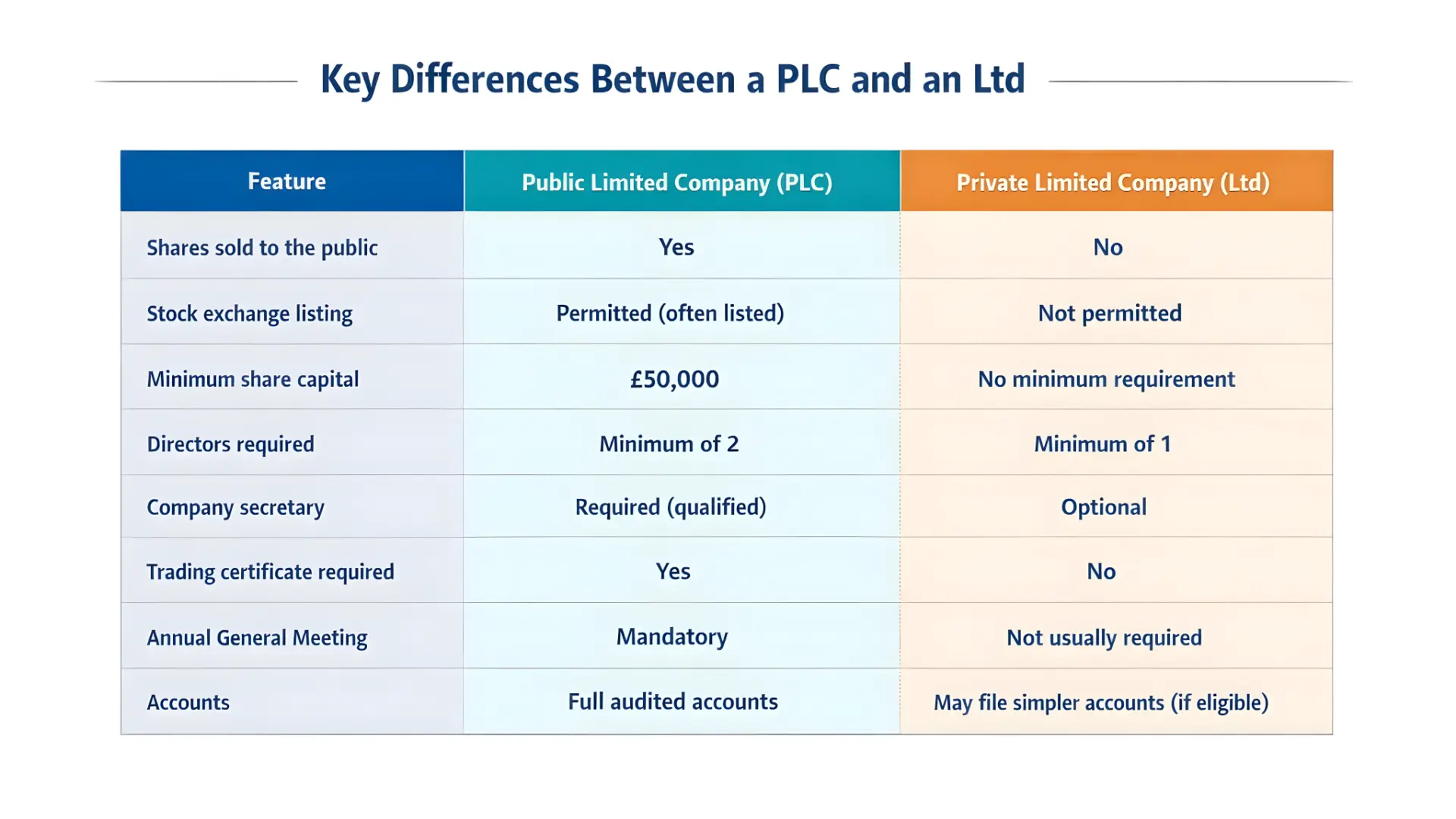
While both structures offer limited liability, there are important legal and operational differences. Unlike private limited companies, public limited companies (PLCs) can offer shares to the public and raise capital from a wider pool of investors.
Which Structure Is More Common?
In the UK, private limited companies (Ltd) are far more common. Most businesses remain private until they reach a significant scale and market leadership. They are simpler to set up, cheaper to operate, and more suitable for small to medium-sized businesses.
Most public limited companies begin life as private limited companies. When these businesses grow to a significant scale and achieve market leadership, they often convert to a PLC to access greater investment opportunities.
Which Is Better: PLC or Ltd?
There isn’t a “better” structure, only a more suitable one.
- A private limited company is typically ideal for small or growing businesses that want limited liability without heavy regulation.
- A public limited company is usually appropriate for large, established businesses seeking substantial external investment and long-term expansion.
The right choice depends on your growth ambitions, funding needs, and appetite for regulation.
Examples of Public Limited Companies in the UK

Many of the UK’s largest and most recognisable businesses operate as public limited companies.
Well-known examples include:
- AstraZeneca plc – A global pharmaceutical company
- HSBC Holdings plc – One of the world’s largest banking groups
- Unilever plc – A multinational consumer goods company
- Rolls-Royce Holdings plc – An engineering and aerospace company
These companies are listed on the London Stock Exchange (LSE) and form part of major stock market indexes such as the FTSE 100, which tracks the 100 largest companies listed in the UK by market capitalisation.
Being included in the FTSE 100 or other major indexes often increases visibility and attracts institutional investors, such as pension funds and asset managers.
Are All PLCs Listed on the Stock Exchange?
Not necessarily.
While many public limited companies choose to list on a recognised stock exchange, listing is not legally required. The defining feature of a PLC is that it is allowed to offer its shares to the public, whether or not it chooses to list them.

Find the Best Accountant

 Previous

